

Key Takeaways
- Plan for 3–5+ years from first outreach to PR; check current estimates on the IRCC processing times page.
- Your Letter of Support from a designated organization is the essential gate to file; Toronto competition and a ten-startup cap per org raise the bar.
- The work permit bridge lets you build in Canada while waiting and is often the smartest move for SaaS traction and hiring.
- Backlogs are real—recent reporting notes waits that can exceed five years; see IMI Daily’s analysis.
- Budget wisely: IRCC fees, org/program costs, counsel, and settlement funds add up; see the 2025 processing and fee guide.
Why the Start-Up Visa Still Matters for SaaS Founders in Toronto (2025)
Big picture: Canada’s Start-Up Visa remains a rare path to PR based on your business, not a job offer. For SaaS founders, avoiding LMIA dependency and pitching designated organizations directly is a meaningful edge.
Toronto’s deep talent pool, investors, and incubators make it a powerful launchpad—though competition is fierce. Start by understanding the program framework on the IRCC Start-Up Visa overview page, then map that to your runway and product roadmap.
What You’re Actually Signing Up For: The 2025 Reality
Expectation setting beats optimism. In 2025, the Canada Start-Up Visa journey is measured in years, not months. Plan for six to twelve months to secure a Letter of Support, three to six months for a work permit, and approximately thirty-one to fifty-two months for PR processing.
You can verify current estimates on the IRCC processing times page. Some cohorts may wait longer; recent reporting points to waits that may exceed five years in certain cases—see this IMI Daily analysis.
Stage 0: MVP Readiness That Strengthens Your Candidacy
What “Immigration‑Ready” Looks Like for a SaaS MVP
Validated innovation: Solve a clear problem in a novel, defensible way—ideally with proprietary data, compliance advantages, or technical depth.
Traction that counts: MRR growth, signed LOIs, active pilots, or measurable user engagement show customers care.
Defensible moat: Explain your competitive edge, IP posture, and team expertise—why you win and scale globally.
Due diligence readiness: Prepare financials, customer contracts, cap table, founder bios, and compliance docs in a clean data room. These fundamentals align with IRCC’s emphasis on innovation, scale, and global competitiveness outlined in the IRCC Start-Up Visa overview.
Connecting SaaS MVP Requirements to Immigration Success
Go global from day one. Position your product for cross-border scale and regulated-market awareness (fintech, health, legal). Build a pitch deck that speaks to investors and immigration reviewers alike—problem/solution with data, market size, competition, unit economics, team roles, traction, roadmap, and why Canada/Toronto accelerates growth.
Designated organizations back teams who execute—traction turns “interesting” into “investable.”
Stage 1: Securing a Designated Organization Commitment (6–12+ Months)
How it works in practice: You’ll pitch, undergo diligence (financial, technical, references), and—if approved—receive a Letter of Support while your organization files a Commitment Certificate with IRCC. Toronto’s density of incubators, angels, and VCs is an advantage, but selectivity is high.
Process rigor varies by org. For a structured overview and program details, see the comprehensive Start-Up Visa guide.
Competition and the cap: Since 2024, each designated organization can back only ten startups per year, intensifying competition and pushing cohort timelines earlier. For context on backlog dynamics and oversubscription, review Global Citizen Solutions’ analysis and IMI Daily’s wait-time reporting.
After the Letter: Treat issuance as the starting gun, not the finish line. Maintain momentum, share milestones with your org, and prepare the filings that come next.
Stage 2: The Work Permit Bridge (Strategic but Optional)
Why it matters: With multi-year PR queues, the LMIA‑exempt Start-Up Visa work permit lets you validate PMF, hire locally, access incubator resources, and demonstrate progress in Canada—often within three to six months. Many founders submit work permit and PR applications in parallel.
For practical timelines and filing context, consult the Start-Up Visa application guide and the 2025 processing and fee breakdown. Plan for proof of funds, family accompaniment options, and diligent record‑keeping of your Canadian operations.
Stage 3: Filing PR—Processing Realities in 2025
What the Numbers Really Mean
IRCC currently posts approximately thirty-one to fifty-two months for Start-Up Visa PR processing nationwide (Toronto included)—see the official IRCC processing times page. Some applicants report longer waits; certain cohorts may exceed five years per this IMI Daily analysis.
Why delays persist: Large backlogs, resource constraints, enhanced scrutiny of business viability and org relationships, and complex security/medical checks all extend timelines.
Priority Processing: Does It Still Help?
Priority pathways via VC/angel investment or top-tier incubators may trim time, but the backlog has diluted the advantage. Expect months saved, not years, as noted in detailed Start-Up Visa pathway analysis.
Operate while you wait: Send regular milestone updates to your org, maintain compliance in Canada, and stay document‑ready for refresh requests. For a holistic view of timelines and fees, see the 2025 Start-Up Visa processing and fee guide.
Stage 4: Toronto‑Specific Dynamics to Plan For
Oversubscription plus the ten‑startup cap means earlier application deadlines, higher selection bars, and longer waitlists at marquee incubators. Begin outreach six to nine months before you intend to apply. For market context, see Global Citizen Solutions and IMI Daily.
What wins in Toronto: Sector depth (fintech, healthtech, enterprise compliance), defensible moats (proprietary data, regulatory expertise, deep technical IP), a clear Canadian go‑to‑market, and a team with complementary skills.
Stage 5: A 12–18 Month Action Plan for MVP‑to‑PR Readiness
Months 0–3: Finalize MVP and Validate ICP
Focus on proof, not perfection. Lock in 3–5 credible pilots or paying users, capture quotes and metrics, and assemble your Start‑Up Visa due‑diligence data room (financials, cap table, contracts, IP, compliance). Build a target list of 10–15 aligned designated organizations.
Months 3–9: Targeted Outreach and Letter of Support
Engage and iterate. Prioritize warm intros, pitch, respond to diligence, and refine based on feedback. Once approved, your org issues the Letter of Support and files the Commitment Certificate—start preparing work permit and PR materials immediately.
Months 9–18: File PR, Bridge with Work Permit, Execute in Canada
Operate on two tracks. Submit PR, file the work permit, establish Canadian presence (banking, entity, early hires), and hit visible milestones—customer growth, product releases, partnerships, fundraising. Keep clean books and send regular updates to your org.
Stage 6: Risk Management, Alternatives, and Next Steps
Manage downside proactively: Build 18–24 months of runway for both business and personal costs, maintain impeccable records, and schedule check‑ins with an immigration professional at key milestones. Scenario plan for pivots, changing org relationships, or slower‑than‑expected traction.
Consider alternatives when needed: Explore PNP entrepreneur streams, Intra‑Company Transfer work permits, or Express Entry if your profile scores well. Policy and processing evolve—monitor the IRCC processing times page and subscribe to official updates.
Program Costs: What You’ll Actually Pay (2025 Estimates)
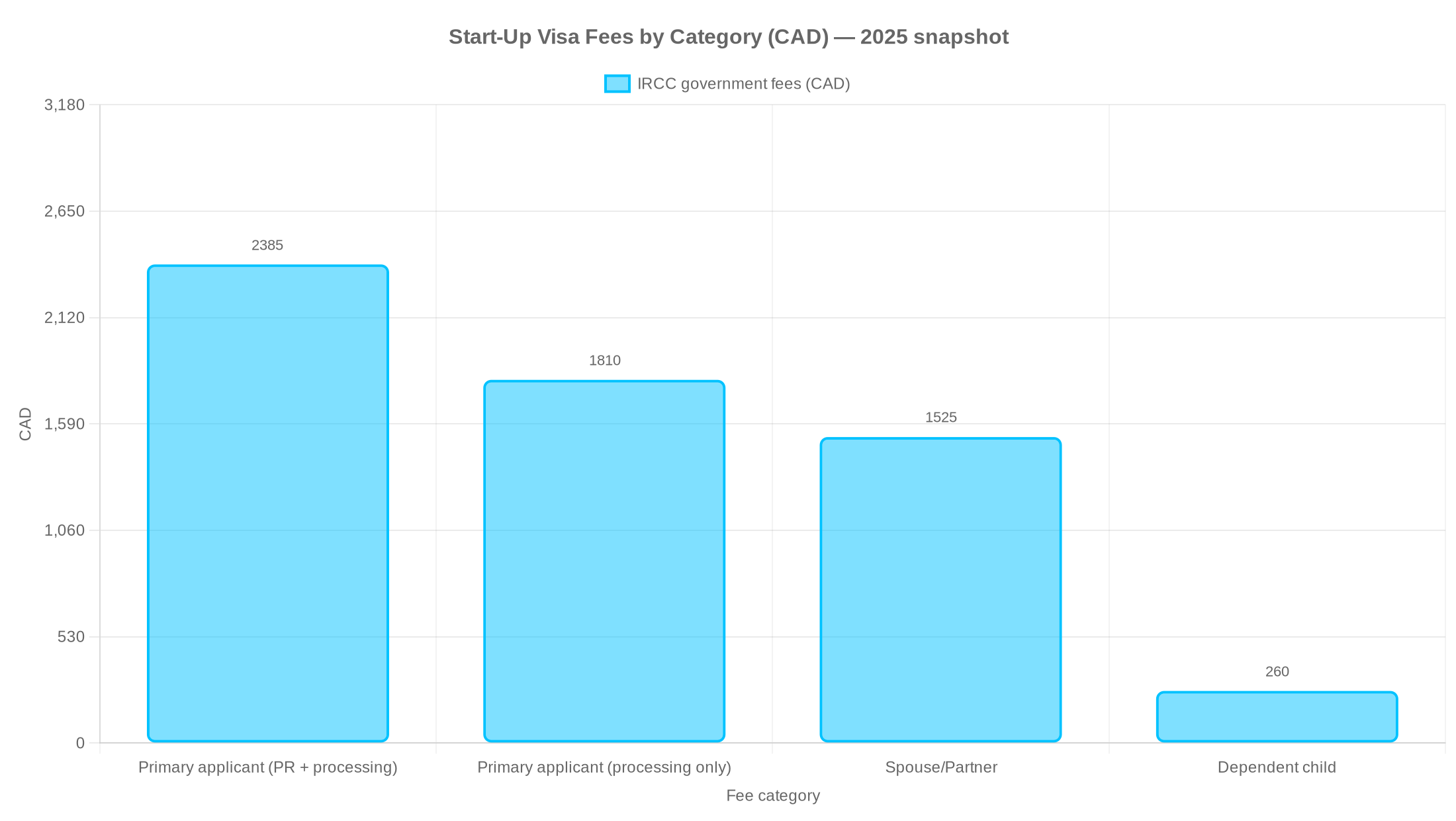
IRCC fees (snapshot): Primary applicant with PR fee: CAD $2,385; processing only: CAD $1,810; spouse/partner: CAD $1,525; dependent child: CAD $260. See the 2025 Start‑Up Visa fee and processing guide and Global Citizen Solutions cost analysis for details and context.
Beyond government fees: Expect designated‑organization program costs (equity and/or fees), professional services, medicals, police certificates, translations, and document prep. Many founders should budget CAD $15,000–$30,000+ for immigration alone, excluding startup operating capital.
Settlement funds: You must show sufficient, unencumbered funds based on family size. For current thresholds, consult the comprehensive Start‑Up Visa guide.
Eligibility at a Glance: Do You Qualify?
Language proficiency: CLB 5 or higher in English/French (IELTS General typical minimums below). Language is non‑negotiable—fall short and the file is refused.
- Reading: 4.0
- Writing: 5.0
- Listening: 5.0
- Speaking: 5.0
Ownership and control: Up to five co‑founders may apply; collectively hold more than 50% voting rights. Each PR applicant must be actively managing the business from Canada (or upon arrival).
Letter of Support: Obtain one commitment only—either CAD $200,000+ from a designated VC fund, CAD $75,000+ from a designated angel group, or acceptance into a designated incubator. See the list and rules on the IRCC Start‑Up Visa overview.
Business requirements: Incorporated and operating in Canada at PR issuance; innovative; scalable with global potential. For a detailed checklist, review the Start‑Up Visa program guide.
Why Sakura Immigration Is Your Strategic Partner
The stakes are high. Long timelines, rigorous diligence, and evolving policy mean small mistakes can cost months. Sakura Immigration’s RCIC‑led team guides SaaS founders from first pitch to PR, blending immigration expertise with Toronto ecosystem know‑how.
End‑to‑end support: We prepare your data room and deck, shape your designated‑organization strategy, file work permit and PR applications, and manage your file over the long arc—keeping you compliant, responsive, and informed.
Built for founders: Multilingual service (English, Turkish, Vietnamese, Chinese, Spanish) and transparent fees ensure clarity at every step. When you’re ready to act, we help turn a strong MVP into a compelling immigration story—and a durable Canadian presence.
Final Thoughts: The Long Game Is Worth Playing
Yes, the Canada Start‑Up Visa timeline in 2025 is longer and more selective. But for execution‑driven SaaS founders, the prize—permanent residence plus access to a world‑class tech ecosystem—is worth the patience and precision.
Play the long game: Plan conservatively, use the work‑permit bridge, maintain momentum, and surround yourself with experienced partners. With the right preparation, you can navigate the Start‑Up Visa MVP to PR timeline and build the company—and the life—you came for.
Frequently Asked Questions
How long does the Start‑Up Visa PR process really take in 2025?
Plan on roughly thirty‑one to fifty‑two months for IRCC PR processing after submission, plus six to twelve months to secure a Letter of Support. Some applicants report longer waits; monitor the IRCC processing times page for updates.
Do I need the work permit, or can I just wait abroad?
The work permit is optional but strategically valuable—it lets you validate PMF, hire, and show progress while PR is pending. Most SaaS founders benefit from being on the ground in Canada during the long PR wait.
What makes a strong Letter of Support application in Toronto?
Clear innovation, credible traction, defensible moat, and a tight Canadian go‑to‑market story. Warm intros, timely cohort targeting, and diligence‑ready materials significantly improve your odds with selective designated organizations.
Does priority processing still speed things up?
It can, but the backlog has narrowed the advantage—expect potential months saved, not years. See this pathway analysis for broader context.
How much should I budget beyond IRCC fees?
In addition to government fees, anticipate organization program costs, professional services, medicals, police certificates, translations, and settlement funds. Many founders allocate CAD $15,000–$30,000+ for immigration‑related expenses alone; see the 2025 fee guide.
Can my family accompany me on the work permit?
Yes. Spouses/partners can often obtain open work permits, and dependent children can accompany you. Ensure proof of funds and complete documentation to minimize delays.
What if my startup pivots after I submit?
Notify your designated organization promptly and document changes. Major shifts in model, team, or market may require updated materials—and transparent communication helps protect your file during IRCC review.
Where can I verify official rules and organizations?
Start with the IRCC Start‑Up Visa overview page for eligibility and designated‑organization details, and cross‑check timelines via the IRCC processing times page.