

Key Takeaways
- Post‑2018 DUIs = serious criminality. Deemed rehabilitation doesn’t apply; you’ll generally need Criminal Rehabilitation after five years post‑sentence or a TRP if you can’t wait. See Deemed Rehabilitation Canada 2025.
- Pre‑2018 single DUI may still qualify for deemed rehabilitation—but only after 10 years from full sentence completion and if strict conditions are met. See How Long Can a DUI Bar You from Canada and How to Fix It and Getting Into Canada with a DUI After 10 Years.
- The clock starts after you finish everything, not on conviction day: fines, probation, suspensions, interlock, and more. IRCC guidance: Rehabilitation for Persons Who Are Inadmissible to Canada.
- TRP vs Criminal Rehabilitation: TRP is temporary and faster; Criminal Rehabilitation is permanent but slower. Many apply for both in parallel. See Deemed Rehabilitation Canada 2025 and How Long Can a DUI Bar You from Canada and How to Fix It.
- Documentation wins the day. CBSA can see expunged/sealed records—arrive prepared or risk refusal. See Deemed Rehabilitated – Canadian Immigration.
Why This Matters in 2025–2026
A single DUI can quietly derail your Canadian plans—study in Vancouver, a client meeting in Toronto, even a permanent residence pathway. The distinction between deemed rehabilitation and Criminal Rehabilitation is the pivot point that determines whether you can enter at all, and when.
Since December 18, 2018, most DUIs are treated as serious criminality in Canada, eliminating the old automatic 10‑year path for many travelers. If your conviction is post‑2018, expect to need Criminal Rehabilitation after five years or a Temporary Resident Permit sooner. See Deemed Rehabilitation Canada 2025.
If your DUI conviction happened after December 18, 2018, you cannot rely on deemed rehabilitation. You’ll need Criminal Rehabilitation once five years have passed from sentence completion—or a TRP before then.
Some pre‑2018 cases can still use deemed rehabilitation, but only with tight conditions and proof at the border. For deeper background, review How Long Can a DUI Bar You from Canada and How to Fix It.
Decision Framework: Deemed Rehabilitation vs Criminal Rehabilitation
Step 1: What Is Your Offence Date?
Before December 18, 2018: A single DUI may qualify for deemed rehabilitation once 10 years have passed from full sentence completion. See Getting Into Canada with a DUI After 10 Years.
After December 18, 2018: DUI is classified as serious criminality (max 10 years’ imprisonment). Deemed rehabilitation is off the table; you’ll need Criminal Rehabilitation after five years post‑sentence or a TRP earlier. See Deemed Rehabilitation Canada 2025.
Tip: Use the conviction or plea date—not the arrest date—when assessing eligibility.
Step 2: Do You Have Aggravating Factors?
Even for pre‑2018 DUIs, certain circumstances disqualify you from deemed rehabilitation altogether. You generally cannot use deemed rehabilitation if you have multiple convictions, bodily injury, notable property damage, a weapon involved, or additional charges tied to the incident. See Deemed Rehabilitation Canada 2025.
Two or more summary convictions can, in rare cases, be deemed rehabilitated after five years—but most DUI cases are treated as hybrid/indictable equivalents that trigger the 10‑year rule or require Criminal Rehabilitation. See Getting Into Canada with a DUI After 10 Years.
Step 3: When Does the Clock Start?
The timeline for both pathways starts only after you complete your full sentence—not the conviction date. “Full sentence” means all jail time, fines paid in full, probation finished, community service completed, driver’s license reinstated if suspended, and any interlock requirement fulfilled. See I Had a DUI 5 Years Ago Can I Go to Canada?
Deemed rehabilitation (pre‑2018 single DUI only): 10 years from sentence completion. See Deemed Rehabilitation Canada 2025.
Criminal Rehabilitation (required for post‑2018 DUI; available to others): Eligible five years after sentence completion. Processing often takes 12+ months—plan ahead. IRCC guide: Rehabilitation for Persons Who Are Inadmissible to Canada.
Bring proof: certified court records, receipts, probation discharge letters, and reinstatement documents. Missing proof is a common reason for refusal at the border.
Step 4: Do You Need to Travel Before You’re Eligible?
If you must enter Canada before reaching the five‑year (Criminal Rehabilitation) or 10‑year (deemed rehab) threshold, a Temporary Resident Permit (TRP) is your lawful bridge for a defined purpose (business trips, conferences, family emergencies). See How Long Can a DUI Bar You from Canada and How to Fix It.
TRP vs Criminal Rehabilitation: TRPs can be faster and temporary; Criminal Rehabilitation is permanent but slower. Many applicants pursue both—TRP for near‑term travel, Criminal Rehabilitation for lasting clearance. See Deemed Rehabilitation Canada 2025.
TRPs are discretionary: strengthen your case with employer letters, invitations, proof of rehabilitation, and evidence of home‑country ties.
Understanding the Fine Print: Deemed Rehabilitation Explained
Deemed rehabilitation is not an application; it’s a legal status you either meet or you don’t. If eligible, you can enter without pre‑filing—but you must be prepared to prove it at the border every time.
Core conditions: pre‑2018 offence; Canadian equivalent punishable by less than 10 years; a single offence (rarely two summary‑only); 10+ years since sentence completion; no new offences. See Deemed Rehabilitation Canada 2025.
What to Bring to the Border
- Certified court records and sentencing order, plus receipts confirming fines paid and probation discharge.
- License reinstatement notice and any interlock completion proof.
- Police certificates/FBI report confirming no subsequent offences.
- Optional but wise: a legal opinion letter confirming deemed rehabilitation under current law—see Getting Into Canada with a DUI After 10 Years.
Myths to avoid: Expunged or sealed doesn’t mean invisible to CBSA, the five‑year rule rarely applies to a DUI, and officers can always ask for proof—even if you believe you’re deemed rehabilitated. See Deemed Rehabilitated – Canadian Immigration and Getting Into Canada with a DUI After 10 Years.
Criminal Rehabilitation: The Permanent Solution
Criminal Rehabilitation is a formal IRCC application that, once approved, permanently removes your inadmissibility for the offences listed. You won’t need to prove eligibility at each crossing—officers can see your approval in their system.
Who Needs to Apply for Criminal Rehabilitation?
- Anyone with a DUI conviction after December 18, 2018.
- Anyone with multiple DUIs, or a pre‑2018 DUI with aggravating factors.
- Anyone seeking permanent certainty instead of relying on border discretion.
- Eligibility begins five years after completing your full sentence—IRCC will return early filings. See Rehabilitation for Persons Who Are Inadmissible to Canada.
Processing Time and Fees
Processing time: often 12 months; complex files can take 18–24 months. Build this into your travel or immigration plans.
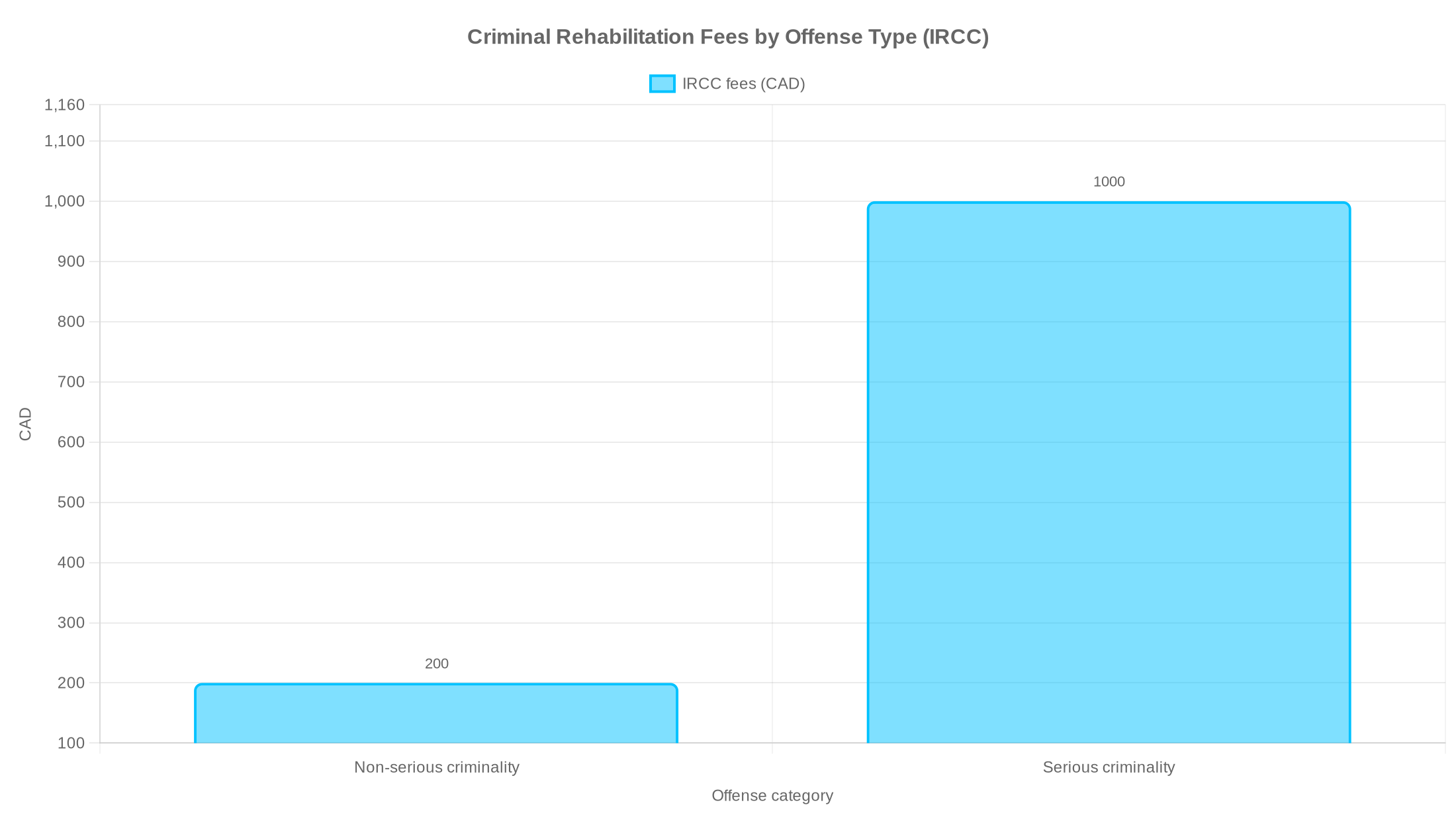
Fees: CAD $200 for non‑serious criminality; CAD $1,000 for serious criminality (which includes most DUI cases). IRCC fee reference: Rehabilitation for Persons Who Are Inadmissible to Canada.
What You’ll Need to Submit
Organize to IRCC’s expectations. In a clean, tabbed package include: identity (passport, photos), certified court records and sentencing orders, proof you finished every part of the sentence, required police certificates, and a concise personal statement with character references. For document specifics, follow IRCC’s instructions in Guide 5312.
Pro tip: Clarity and completeness speed reviews. Disorganized or incomplete files are the top cause of delays and returns.
Why Apply If You’re Already Deemed Rehabilitated?
Peace of mind and predictability. With Criminal Rehabilitation, you stop relitigating your past at each entry and avoid officer‑by‑officer discretion. For frequent travelers or anyone pursuing PR, it’s often worth the investment. See How Long Can a DUI Bar You from Canada and How to Fix It.
TRP vs Criminal Rehabilitation: Which One—or Both?
If you need to travel soon and aren’t yet eligible for Criminal Rehabilitation, a Temporary Resident Permit (TRP) can authorize short‑term entry for a specific purpose. Many applicants file a TRP for immediate needs and, in parallel, submit Criminal Rehabilitation for permanent clearance. See Deemed Rehabilitation Canada 2025.
- Use a TRP when urgency rules: upcoming business, family emergencies, or time‑sensitive opportunities. Consular processing is more predictable than at the border; allow several weeks to a few months—see How Long Can a DUI Bar You from Canada and How to Fix It.
- Use Criminal Rehabilitation once the five‑year mark passes and you want permanent clearance, especially for frequent travel or PR pathways.
- Use both when you need near‑term access and long‑term certainty.
Real‑World Scenarios: What Path Fits You?
Scenario A: Single Pre‑2018 DUI, No Complications
Background: Maria’s DUI conviction was in June 2012 (California). She paid the fine, completed education, and probation ended September 2012. No other offences.
Analysis: Pre‑2018, single offence, 10+ years since sentence completion—she likely qualifies for deemed rehabilitation.
Path: Bring certified records, completion proof, and an FBI report. A legal opinion letter can smooth inspections—see Getting Into Canada with a DUI After 10 Years. Optional: apply for Criminal Rehabilitation for official confirmation—see Deemed Rehabilitated – Canadian Immigration.
Scenario B: Single Post‑2018 DUI, Urgent Business Travel
Background: Ahmed’s DUI conviction was March 2020 (Texas). Probation ended September 2021. He needs to travel in May 2025.
Analysis: Post‑2018 DUI = no deemed rehabilitation. Criminal Rehabilitation eligibility starts September 2026.
Path: Apply now for a TRP with employer letter, certified court records, proof of completion, and a personal rehabilitation statement; processing often takes 4–8 weeks—see How Long Can a DUI Bar You from Canada and How to Fix It. Long‑term, file Criminal Rehabilitation at eligibility—see I Had a DUI 5 Years Ago Can I Go to Canada?.
Scenario C: Two DUIs, One Pre‑2018 and One Post‑2018
Background: Javier’s convictions: 2015 (completed 2016) and 2019 (completed 2020). It’s now 2025.
Analysis: Multiple offences disqualify deemed rehabilitation. He became eligible for Criminal Rehabilitation in 2025 (five years after most recent completion). IRCC guidance: Rehabilitation for Persons Who Are Inadmissible to Canada.
Path: File Criminal Rehabilitation with certified records for both cases, completion proof, police certificates, statement, and references. Fee likely CAD $1,000 for serious criminality—see Canadian Criminality and Inadmissibility FAQs. If urgent travel arises during processing, apply for a TRP in parallel—see How Long Can a DUI Bar You from Canada and How to Fix It.
Common Pitfalls and How to Avoid Them
1. Miscounting the timeline. The clock starts after everything is complete—fines, probation, suspensions, interlock—not on conviction day.
2. Assuming expunged = invisible. CBSA can see many sealed/expunged records; always disclose honestly to avoid a five‑year misrepresentation ban.
3. Arriving unprepared. Deemed rehabilitation is automatic only if you can prove it with certified records and completion documents.
4. Filing too early. IRCC returns Criminal Rehabilitation applications submitted before the five‑year eligibility date.
5. Overlooking aggravating factors. Injury, property damage, weapons, or extra charges can push you out of deemed rehabilitation—get a professional assessment.
Why Sakura Immigration for Deemed vs Criminal Rehabilitation
Expertise you can trust. Our RCICs have a decade of combined experience with DUI inadmissibility, from pre‑2018 deemed cases to post‑2018 serious‑criminality files. We stay current on Bill C‑46 and CBSA enforcement trends.
Multilingual support. Consult in English, Turkish, Vietnamese, Chinese, or Spanish—clarity matters when timelines and eligibility are on the line.
Transparent, fixed fees. No surprises. You’ll know exactly what’s included: assessment, document prep, legal opinion letters, filing, and follow‑up.
Officer‑ready documentation. We present your case the way IRCC and CBSA prefer—concise, complete, and easy to approve.
Strategy that fits your goals. Whether you need deemed rehab proof, a TRP for urgent travel, or Criminal Rehabilitation for permanence, we map the route and milestones.
Your Next Steps: Book a Multilingual Assessment
Here’s what happens when you book with Sakura Immigration:
- Case review. We verify offence date, Canadian equivalency, and sentence‑completion evidence.
- Pathway mapping. Deemed rehabilitation now, Criminal Rehabilitation timing, or TRP as a bridge.
- Document checklist. Exactly what to gather, where to get it, and how to certify it.
- Timeline and fees. Realistic IRCC/consular timing and a fixed‑fee quote.
- Travel‑readiness plan. A clear playbook for your next crossing or application.
Frequently Asked Questions
Does a post‑2018 DUI ever qualify for deemed rehabilitation?
No. After December 18, 2018, DUIs are treated as serious criminality in Canada, which blocks deemed rehabilitation. You’ll typically need Criminal Rehabilitation after five years from sentence completion or a TRP for earlier travel—see Deemed Rehabilitation Canada 2025.
When exactly does my eligibility clock start?
On the date you completed your entire sentence—fines paid, probation done, suspensions/interlock ended, and any community service finished. IRCC confirms this approach in Guide 5312.
Can I travel while my Criminal Rehabilitation is processing?
Possibly, if you obtain a Temporary Resident Permit. TRPs can be processed at consulates (more predictable) or occasionally at the border (riskier). See guidance in How Long Can a DUI Bar You from Canada and How to Fix It.
Do expunged or sealed DUIs still cause problems at the Canadian border?
They can. CBSA often has visibility into FBI and state records, and failing to disclose can lead to a five‑year misrepresentation ban. See Deemed Rehabilitated – Canadian Immigration.
I have a single pre‑2018 DUI—do I need to apply for anything?
If you meet all conditions for deemed rehabilitation (single offence, 10+ years since sentence completion, no aggravating factors), you may not need to apply. Still, carry proof and consider a legal opinion letter—see Getting Into Canada with a DUI After 10 Years.
How much does Criminal Rehabilitation cost?
IRCC charges CAD $200 for non‑serious criminality and CAD $1,000 for serious criminality—most DUI cases fall into the latter. Reference: Guide 5312.
What if I have two DUIs?
Multiple offences disqualify deemed rehabilitation. You’ll need Criminal Rehabilitation (eligible five years after the most recent sentence completion). See Canadian Criminality and Inadmissibility FAQs.
Should I still apply for Criminal Rehabilitation if I’m deemed rehabilitated?
Often yes, for convenience and certainty. An approval removes officer discretion and future document‑carrying burdens—see How Long Can a DUI Bar You from Canada and How to Fix It.