

Key Takeaways
- Rules tightened in 2025: SOWP is now focused on spouses of TEER 0–1 workers or those on approved PR pathways; see the official guide: Open work permits for family members of foreign workers.
- 2026 watchlist (unconfirmed): Potential language testing and continued high-skill focus, echoed by the Abhinav newsletter.
- PR pathway = safety lane: Express Entry/PNP/AIP approval can keep your spouse eligible even outside TEER 0–1; re-check requirements on Canada.ca.
- Timelines matter: Processing often takes 4–6 months. Build a document calendar now to avoid delays.
- Treaty exceptions exist: Some FTA-based workers may still qualify their spouses—verify the specific terms on Canada.ca.
Why SOWP Matters Now—and Why to Prepare for Changes
A spouse open work permit lets your partner work for any employer while your family builds a life—and PR prospects—in Canada. That freedom can unlock Canadian work experience, strengthen Express Entry points, and stabilize day-to-day life.
As of January 2025, IRCC narrowed eligibility to spouses of TEER 0–1 workers or those already on an economic-class PR pathway. Spouses of low-skilled workers (TEER 4–5) are generally excluded, and dependent children can no longer apply for open work permits. The rules live on Canada.ca—treat it as your single source of truth.
Act early—processing, police checks, and translations take time. Waiting for a formal 2026 announcement could put you months behind prepared families.
What Could Change in 2026 (Evidence-Based, Clearly Labeled as Unconfirmed)
Language Testing for Open Work Permits
Several commentators suggest IRCC may require English/French test results for some open work permit categories in 2026. See reporting from Land2Air and the Abhinav newsletter—both note it’s not official yet.
What to do: Pre-book IELTS/CELPIP or TEF/TCF for mid-2026 with flexible rescheduling. If the rule lands, you’re ready; if not, you’ve only spent the test fee.
“SOWP Clarification Q: If a Spousal Open Work Permit says …” — Manny Lidher (X)
REP-2025-0140- SOWP Clarification
Q: If a Spousal Open Work Permit says “Only valid while spouse is a full-time student”, does it become invalid if the student finishes early?
A: No. If issued correctly, it remains valid until expiry. Extension rules differ.#CanadaVisa… pic.twitter.com/TsTaLfM3GF
— Mandeep Lidher (@MannyLidher) December 18, 2025
TEER-Based Eligibility Tightening
The 2025 framework centers on TEER 0–1 roles, with limited routes for TEER 2–3 when the principal is on a PR pathway. Low-TEER workers (TEER 4–5) remain largely ineligible, as summarized by Immigrant Women Services. Confirm your scenario on Canada.ca at filing time.
What to do: Verify the NOC code and TEER level with HR and plan for a PR pathway if you’re in TEER 2–3 to safeguard SOWP access.
PR Pathways as a Safety Lane
Approved economic-class PR applications—Express Entry, PNP, or AIP—can preserve SOWP eligibility even if the job isn’t TEER 0–1. The minimum remaining validity for the principal’s work permit may be only six months in PR-pathway cases (versus sixteen months otherwise).
What to do: Launch PR early. An AOR, nomination certificate, or IRCC acknowledgment strengthens the spouse’s case and shortens the “validity left” threshold.
Free Trade Agreement Exceptions
Some treaty workers—e.g., under CUSMA—can still qualify their spouses irrespective of TEER, depending on the agreement terms. Cross-check treaty specifics on Canada.ca and review the overview from Immigrant Women Services.
What to do: Confirm if the principal’s permit is FTA-based and assemble treaty-related documentation early.
Keep Speculation Transparent
Other rumored tweaks—like licensing checks or added admissibility screening—are not official. Treat them as “watch and prepare,” not guarantees.
Spouse Open Work Permit Decision Tree (2026-Era, Practical and Verifiable)
1) Is the principal’s work permit valid? If not, stop. They need valid status or an approval-in-principle first.
2) Is the job TEER 0–1? If yes (and no PR pathway), the permit typically needs at least 16 months remaining at receipt; verify on Canada.ca. If on a PR pathway, 6 months remaining is often enough.
3) TEER 2–5? PR approval may salvage eligibility (with the 6‑month validity rule). Without PR—and no FTA exception—the spouse is generally ineligible.
4) FTA workers (e.g., CUSMA): Treaty provisions may allow SOWP regardless of TEER. Confirm on Canada.ca.
6–12 Month Readiness Plan (How to Prepare for SOWP 2026 Changes)
Step 1: Confirm the Principal’s TEER Level and Status (Month 1)
Request an employment letter with job title, duties, and NOC code; confirm TEER using the official NOC 2021 lookup. Check the permit’s expiry and ensure remaining validity aligns with the 16‑month (non‑PR) or 6‑month (PR-pathway) thresholds on Canada.ca.
Step 2: Fortify Relationship Evidence (Months 1–3)
Married couples submit a marriage certificate (certified translation if needed). Common-law partners document 12+ months of cohabitation—joint lease/mortgage, shared utilities/banking, and statutory declarations—plus a modest set of photos and communication history.
Step 3: Start Language-Readiness Now (Months 2–4)
Rumors from Land2Air and Abhinav suggest possible language requirements in 2026. Book IELTS/CELPIP or TEF/TCF 4–6 months ahead, target CLB 5–6+, and keep the score valid (2 years) to stay agile.
Step 4: Assess FTA Routes (Months 2–3)
If the principal’s permit is FTA-based (e.g., CUSMA, CETA), review family eligibility and collect treaty-specific proofs. Cross-check guidance on Canada.ca.
Step 5: Align with a PR Pathway in Parallel (Months 3–6)
Build an Express Entry profile and explore PNPs to secure AOR or nomination—your SOWP “insurance.” Use the official CRS tool, consider ECAs, and have both spouses take language tests to boost competitiveness.
Step 6: Build a Filing Calendar with Buffers (Months 4–12)
- Police certificates: Many countries need 4–12 weeks—start immediately.
- Biometrics: Book promptly upon receiving IRCC instructions.
- Medical exam: Schedule with an IRCC panel physician via the official list.
- Language test: Reserve 3–4 months ahead; results in roughly two weeks.
- Permit renewal: If the principal is short of the validity threshold, initiate renewal early.
SOWP Application Checklist 2026 (Tailored for Fast Assembly)
Principal Worker Documents
- Copy of current work permit showing status and expiry.
- Employment letter with job title, NOC, duties, salary, and employer contact.
- Recent pay stubs (e.g., last three) proving ongoing employment.
- Proof of remaining validity aligned to 16 months (non‑PR) or 6 months (PR pathway).
- PR proof if applicable (Express Entry AOR, PNP nomination, or IRCC acknowledgment).
Reconfirm thresholds and any updates on Canada.ca before filing.
Relationship Proof
- Marriage certificate (certified translation if needed) or common‑law declarations.
- Joint housing documents (lease/mortgage) and shared utilities.
- Joint financials (bank/credit statements) spanning several months.
- A concise photo timeline and communication summary.
- Sworn declarations from friends/family (for common‑law).
Spouse Documents
- Valid passport covering the requested permit period.
- Current Canadian status (if in Canada) or restoration proof if applicable.
- Police certificates for all jurisdictions (6+ months since age 18).
- Biometrics appointment confirmation after submission.
- Proof of funds if requested; see LICO references for context.
Forms and Fees
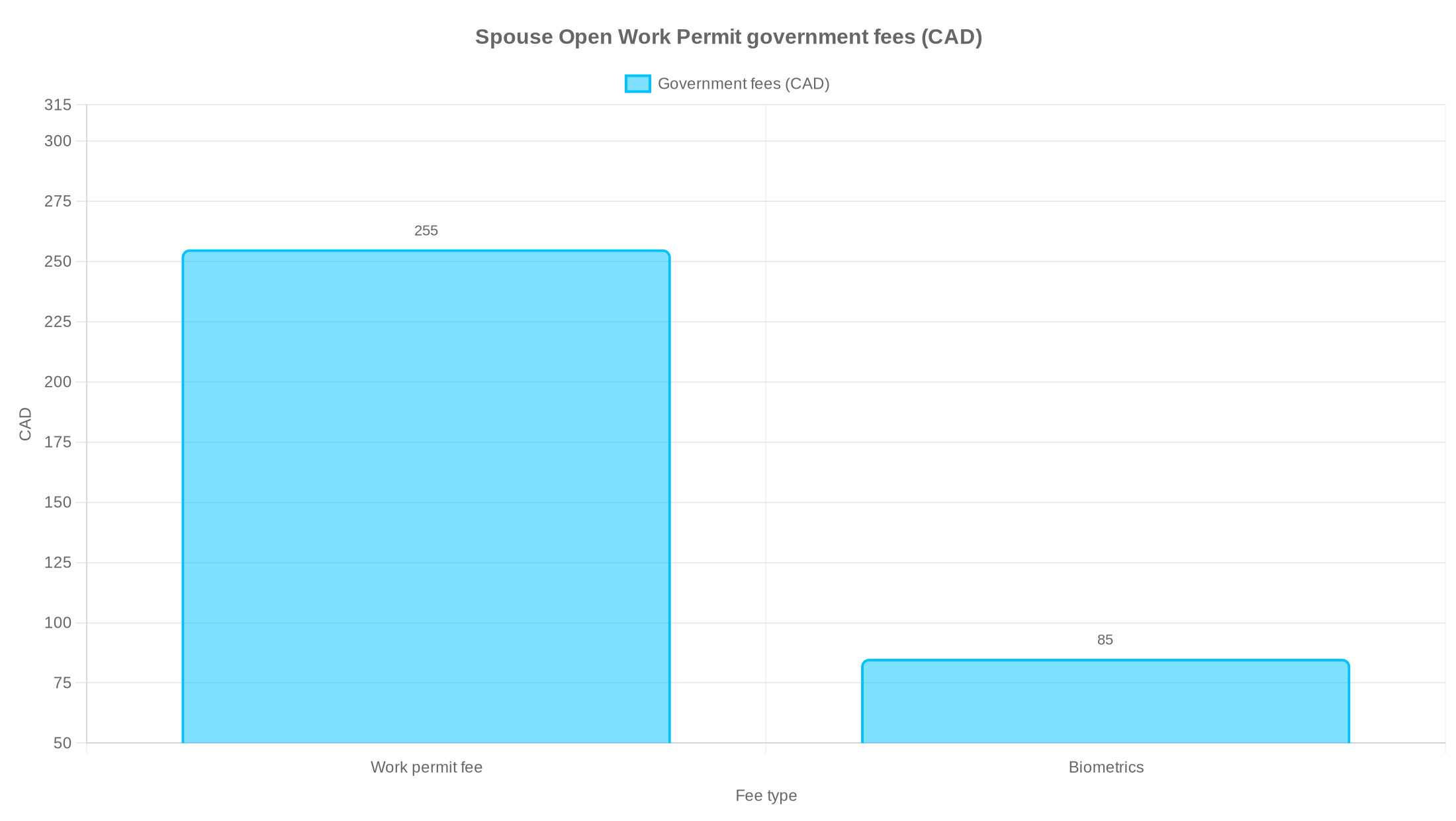
In-Canada: Apply online via the IRCC Portal (or IMM 5710). Outside Canada: Use IMM 1295 online or via a VAC. Current fees (early 2025) are about CAD 255 for the work permit plus CAD 85 for biometrics—verify the latest amounts on IRCC fee pages such as the PR fee schedule.
2026 Prep Additions
- Language test results (IELTS/CELPIP/TEF/TCF) if implemented.
- Evidence of active language study (ESL/FSL certificates).
- Updated résumé and work history for market readiness.
Real-World Scenarios and Quick Wins
Scenario 1: TEER 0 Manager with No PR Plans
Profile: Marketing manager (TEER 0) with a permit valid past 16 months; spouse is on a visitor record.
- Order police certificates now and gather joint housing/financial proofs.
- Pre-book IELTS for mid‑2026 as a precaution.
- File online several months before the visitor record expires to avoid gaps.
Outcome: Strong approval odds under current and likely 2026 rules; language results avoid last‑minute surprises.
Scenario 2: TEER 3 Tradesperson with Express Entry in Progress
Profile: Automotive service technician (TEER 3) with Express Entry AOR; spouse on a study permit expiring soon.
- Attach Express Entry AOR to prove the PR pathway.
- Confirm at least 6 months of permit validity remain at filing.
- Translate marriage certificate via a certified translator and submit early.
Outcome: Eligible via PR-pathway despite TEER 3; language testing likely unnecessary for PR-stream cases if introduced selectively.
Scenario 3: PGWP Holder Job Hunting
Profile: Principal works part-time in TEER 2 while seeking a TEER 0–1 role; spouse is abroad and prepping documents.
- Target TEER 0–1 roles and launch PR in parallel (Express Entry/PNP).
- Spouse prepares passport, police checks, and relationship proof now.
- Apply the moment the principal secures a qualifying job or PR approval.
Outcome: Achievable with PR as the safety net if a TEER 0–1 offer takes time.
Universal quick wins: Order police checks early, pre-book a language test with flexible rescheduling, confirm NOC/TEER with HR, and keep a shared, clearly labeled document folder for one‑day filing readiness.
How Sakura Immigration Helps Families Navigate SOWP 2026 Rules
We’ve guided hundreds of families through work permits and PR pathways. With SOWP rules tightening, our RCICs bring structure and speed when time and accuracy matter most.
- Eligibility assessments: Clear answers across TEER, validity, and PR-pathway scenarios.
- TEER and employer verification: We obtain and confirm the right NOC documentation.
- PR-pathway mapping: Tailored routes through Express Entry, PNPs, or AIP.
- Language-test planning: Strategy for test choice, timing, and target CLB.
- Document & e-filing support: Translations, declarations, and end-to-end IRCC Portal submission.
We serve clients in English, Turkish, Vietnamese, Chinese, and Spanish. Book a consult to turn complex rules into a simple, time-bound plan.
Next Steps: Turn Preparation into Action
Start with the decision tree, verify TEER and permit validity, and align with a PR pathway if needed. Then execute the six-step readiness plan—police checks, language test booking, relationship proof, and a buffer-filled calendar.
If you want expert review before filing, our RCICs can assess eligibility, confirm documents, and submit a polished application. Preparation now means faster filing—and fewer surprises—if 2026 brings new requirements.
Frequently Asked Questions
Are language tests definitely required for spouse open work permits in 2026?
Not yet. Sources like Land2Air and Abhinav say IRCC is considering it, but nothing is official. Prepare a score proactively—if the rule lands, you can file immediately.
My spouse’s work permit expires in 14 months—can I still apply for SOWP?
Under current rules on Canada.ca, TEER 0–1 cases without a PR pathway generally need 16 months of validity at receipt. If on a PR pathway (e.g., Express Entry AOR), 6 months may suffice—otherwise, extend first, then apply.
We’re common-law partners—what proof does IRCC expect?
Show at least 12 consecutive months of cohabitation with joint housing and finances, plus statutory declarations and a concise photo/communication record. For context on the tightened framework, see Immigrant Women Services.
Can I work while my SOWP application is processing?
If you extend a valid work permit before it expires, you may continue under maintained status until IRCC decides. If switching from visitor/study status to your first work permit, you must wait for approval—confirm specifics on Canada.ca.
What if my partner’s job is TEER 2—are we out of luck?
Not if the principal has PR approval (Express Entry, PNP, or AIP). With proof of PR progress and at least 6 months of work permit validity at filing, the spouse may qualify. Without PR approval, eligibility is unlikely unless an FTA exception applies.
How long does SOWP processing take?
In early 2025, many applications take 4–6 months in Canada; outside-Canada timelines vary. Always check the IRCC processing times tool and submit a complete file to avoid delays.
Can I include my children on my SOWP application?
As of Jan 21, 2025, dependent children of foreign workers are no longer eligible for open work permits. They may pursue study permits or visitor records; see the latest policy at Canada.ca.